— Field Notes No. 13
The Organization Has to Change
AI does not just make the old revenue organization faster. Once software can carry the repeatable work, the organization itself has to be redesigned.
A few things happened almost on top of each other.
Google's Ads Advisor and Analytics Advisor now let users ask natural-language questions, surface tailored recommendations and analyze data without leaving the advertising workflow. In Google Ad Manager, a separate beta called Ask Ad Manager can generate reports, tables and comparative benchmarks from a prompt instead of requiring someone to stitch the pieces together manually. (Google Ads & Commerce, March 25, 2026; Google Ad Manager, June 18, 2026)
OpenAI is no longer just an AI company that might someday have an advertising business. It's gradually rolling out a beta self-serve Ads Manager through which advertisers can buy and manage ChatGPT campaigns, and it has launched pixel-based measurement and a Conversions API. (OpenAI, May 5, 2026)
Then came one of the stranger stories of the summer. According to Digiday, TIME is piloting ads intended for AI agents with Mobian: sponsored, FAQ-form brand information placed on markdown versions of TIME pages so machines can read it directly. That's commercial information designed for a machine audience, not simply for the person looking at a webpage. (Digiday, July 30, 2026)
And in local media, Scripps is working through a much harder version of the same conversation. The company has publicly tied its transformation plan to AI, automation and other technology, while reorganizing local and national television leadership to pursue growth and efficiency. (Scripps Q1 results, May 7, 2026; Scripps organizational realignment, July 22, 2026)
Those sound like four different stories. I don't think they are. I think we're starting to see the revenue organization itself change.
We keep aiming AI at the old organization
I wrote recently that the work was never the value. Most companies are still using AI to make existing tasks a little faster. Write the email faster. Build the report faster. Summarize the meeting faster. Make the proposal faster.
That's useful. It also leaves the basic operating model untouched.
The seller still researches the account. The seller still prepares for discovery. After the sale, a strategist or account manager may become the client's primary point of contact. Someone still builds the proposal. Someone enters the order. Someone asks for the creative. Someone traffics it. Someone checks the campaign. Someone assembles the report. Someone remembers that the client is due for renewal.
We've automated pieces of the work while preserving an organization built around people carrying the work. That's the part I think changes next.
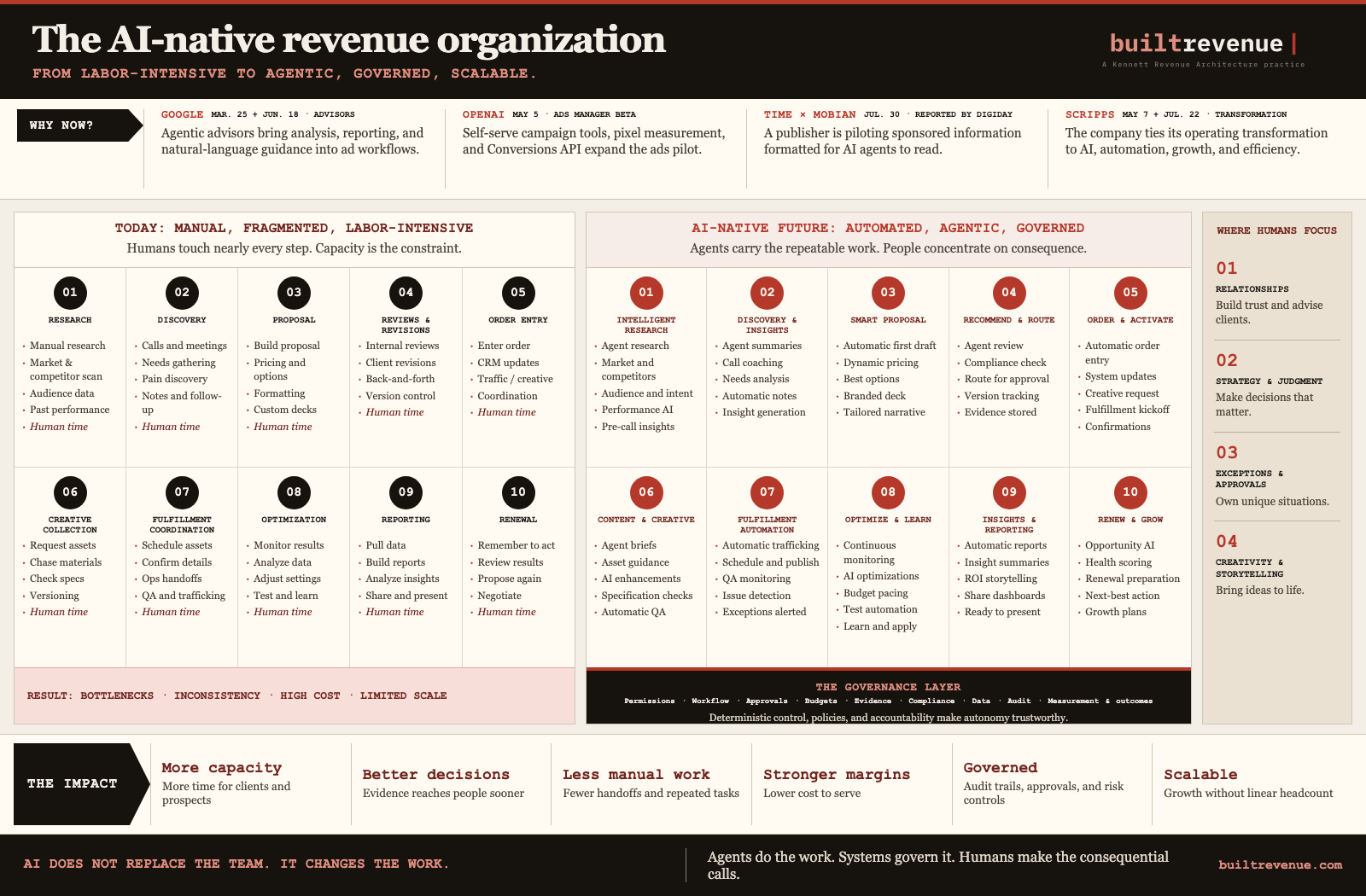
For decades, revenue organizations were designed around an obvious constraint: if work needed to happen, a person had to do it. So we organized people around the tasks — research, sales, proposals, ad operations, creative, campaign management, reporting, account management — and then built software to help all of those people do their individual jobs. CRM records the seller's activity. The proposal platform helps build the deck. The project-management system tells operations what's due. The ad platform lets a campaign manager optimize. The reporting platform helps somebody assemble the results.
It's an enormous stack of software built mostly to help humans carry work from one human to the next.
AI changes the underlying assumption. If software can now research the account, prepare the seller, capture the discovery, assemble the recommendation, draft the proposal, create the order, request the assets, monitor fulfillment, identify a pacing problem, build the report and flag the renewal opportunity, then the question is no longer:
How do we help our people do all of this faster?
The better question is:
Why are our people doing all of it in the first place?
The people doing the relationship work should stop being the workflow
Look at a good local-media seller. The scarce thing isn't her ability to enter an order. It isn't her ability to hunt through five websites before a meeting, resize a logo for a proposal, chase an advertiser for creative or remember to check a dashboard on Thursday morning.
The scarce thing is that the business owner answers when she calls.
She knows the market. She knows which new restaurant is opening before the sign goes up. She knows why the dealership stopped advertising last year. She understands whether the owner sitting across the table actually has a marketing problem or a cash-flow problem. That relationship took years to build.
And the seller isn't always the person doing that work. At the Star Tribune, many of our long-term digital agency relationships weren't led by sellers after the sale. Strategists and account managers became the client's primary point of contact.
The title isn't the point. What an organization calls these people will vary. The work is the point: holding the context, earning the trust, advising the client and owning the consequence.
Yet we routinely surround the people doing that work with administrative work and call the resulting number "capacity." Then we add headcount when the client-facing team runs out of hours.
AI creates the opportunity to change that math. Not by removing the people doing the relationship work — by removing the machinery they've been carrying around. If ten of them could spend materially more of their time talking to prospects, advising clients, finding opportunities and keeping business rather than moving information between systems, the economic impact is much larger than "we saved everyone four hours."
That's why capacity is a better AI metric than productivity. Productivity asks how quickly someone completed the same work. Capacity asks how much more valuable work the organization can now absorb. They aren't the same thing.
The agent is not the system
There's another mistake waiting for us: moving straight from an organization where humans do everything to one where we imagine an AI agent doing everything. That's not the operating model I want either.
An agent might research the advertiser. It shouldn't decide whether it's allowed to expose confidential client data. An agent might recommend a media plan. It shouldn't invent the company's margin floor. An agent might assemble an order. It shouldn't decide that a missing political disclosure probably doesn't matter. An agent might detect that a campaign is underperforming and recommend a change. It shouldn't necessarily get an unlimited budget and permission to make it.
This is the layer that gets missed in a lot of the agent conversation. There still has to be a system: permissions, workflow state, approvals, budgets, evidence, compliance, client data, audit trails. The more work agents can perform, the more important that layer becomes.
Which leads to a model I keep coming back to:
Agents do the work. Systems govern the work. Humans make the consequential calls.
The exact line will move over time. Agents will get better, and some approvals that need a person today will be safe enough to automate tomorrow. But the distinction matters. Autonomy without governance isn't an operating model. It's a demo.
What is left for the humans is the good part
This is also why I'm uncomfortable when the conversation starts and ends with headcount.
Yes, jobs will change. Some will disappear, and it would be dishonest to pretend otherwise. Scripps itself has described a transformation that uses AI, automation and other technology to fundamentally change how the company operates. (Scripps, May 7, 2026)
But "how many people can we eliminate?" is still the smallest version of the question. For many local media companies, the constraint isn't that they have too many talented people. It's that talented people spend too much time doing work that doesn't require their talent.
Take away the machinery and what's left? Relationships. Judgment. Strategy. The weird exception that doesn't fit the rules. The advertiser who needs to hear that the campaign they're asking for is the wrong one. The idea nobody asked the software to generate. The story. The negotiation. The decision where somebody actually has to own the consequence.
Those aren't the scraps left over after automation. They're the valuable part.
The economics are different from the org chart
This is the piece media operators should be working through now. Not a list of AI tools. Not an AI committee. Not another round of licenses so everyone can write faster.
Take one revenue process from beginning to end — research to renewal — put every piece of work on the table, and ask three questions:
Who should actually do this?
What part could an agent carry?
What must the operating system govern?
You may discover that the boxes on the org chart describe tasks that no longer need to be jobs. You may also discover the opposite: there are valuable things you've never been able to afford to do, because every new service required another person.
That's where this gets especially interesting for local media. A publisher that could never afford deep pre-call intelligence for every advertiser may now be able to provide it. A small agency that couldn't assign an analyst to every account may effectively have one. A newsroom that could never support a salesperson with bespoke research, category intelligence and proposal strategy may no longer have to choose. Products that didn't work economically when every step required labor may suddenly work.
That isn't simply cost reduction. It's a different production function.
The valuable layer sits above the platforms
There's another implication here. As advertising platforms automate more of the campaign work, knowing which buttons to push becomes less valuable.
The platforms are already moving in that direction. Google is automating more targeting, creative, bidding, budgeting and pacing through AI Max and related campaign tools. Snap has announced an MCP server that opens its advertising platform to third-party AI agents for planning, creation, optimization and scaling. (Google Ads & Commerce, April 15, 2026; Google Ads & Commerce, May 7, 2026; Snapchat for Business, June 18, 2026)
That doesn't eliminate the need for an operating system. It makes the operating system more important.
The valuable layer sits above the platforms. It knows the advertiser's actual business objective. It carries the publisher's first-party data and the history of the client relationship. It decides which agent can use which information, which actions require approval and where the budget limits are. It records what happened, why it happened and what evidence supported the decision. And it measures whether all of that activity produced an economic result.
That last part matters. An organization should be able to see the cost of a workflow, the human time it released, the work the agents completed and the revenue or margin that followed. Otherwise we're still measuring AI by activity instead of value.
For publishers and agencies, this is the strategic opportunity: not rebuilding Google, Meta or every other platform, and not simply reselling access to an AI tool. Build the governed layer that coordinates the platforms around the client's business, the publisher's data and a measurable outcome. That's a much more defensible place to operate than between the user and the next button.
Don't automate the org chart
The easiest way to implement AI is to drop it into the organization we already have. Give every department a tool. Automate a task here. Add a copilot there. Declare success because everyone saved a little time.
The harder move is to ask whether we'd design the organization this way at all if we were starting today. Would the people doing the relationship work still touch ten systems? Would a person still manually move an approved proposal into an order? Would campaign performance wait until the monthly report to get interpreted? Would someone still need to remember a renewal date? Would five different employees touch the same client information simply because five different software systems require them to?
Probably not.
So I wouldn't start with the question I hear most often:
Where should we use AI?
Start with this one:
If we were building this revenue organization today, knowing what software can now do, what work would we still choose to give to people?
That answer is the organization you should be building toward.
AI doesn't replace the team. But it should absolutely change the work we ask the team to do.
Sources
Google Ads & Commerce: “5 ways to collaborate with our agentic advisors,” March 25, 2026
Google Ad Manager: “Introducing Ask Ad Manager,” June 18, 2026
Digiday: “Time has started serving ads to AI agents,” July 30, 2026
Scripps: television organizational realignment, July 22, 2026
Google Ads & Commerce: “Google’s Dynamic Search Ads are upgrading to AI Max,” April 15, 2026
Google Ads & Commerce: “Google Marketing Live 2026: bidding and budgeting news,” May 7, 2026
Snapchat for Business: “Human-First, AI-Enabled: Snap’s Latest Ads Innovations,” June 18, 2026
Built Revenue · Field Notes No. 13 · https://www.builtrevenue.com/field-notes/the-organization-has-to-change
— Get the next note
The full essay, by email, when it publishes. No filler, unsubscribe anytime.
Field Notes are the argument. The AI Readiness Assessment is the version we run with your team.
Scope an AI Readiness Assessment →