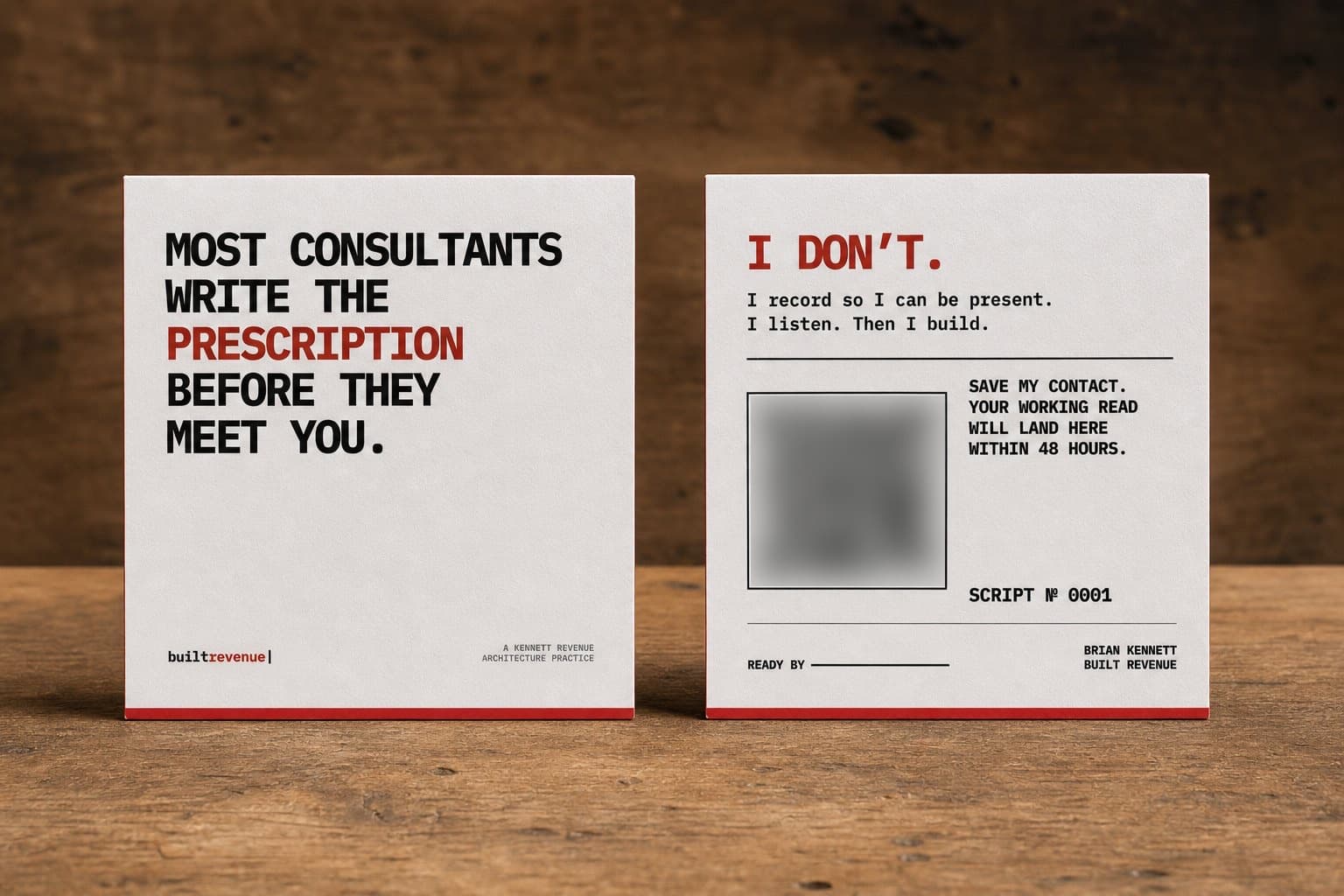
The conversation continues behind the card.
The same QR code opens a page about what we discussed, the resources that matter to you and a useful next step. A whole table can leave with individual follow-ups, too.
See the personal follow-up I use →Operator-led advisory and implementation for local media: rebuilding the revenue that funds the journalism.
Twenty years carrying the number, now building the systems that make revenue durable enough to fund the journalism.
Preparing for a meeting. Working through an offer. Following up with something useful. See how the practice runs, then explore what that could mean for a media seller and the team behind them.
The same QR code opens a page about what we discussed, the resources that matter to you and a useful next step. A whole table can leave with individual follow-ups, too.
See the personal follow-up I use →The last conversation, the open question and the work already done belong together. Bring that context into the next meeting and the next proposal.
“Prepare me for the meeting. Test the margin. Help me draft the proposal.”Follow my day. Imagine your seller. →
Price, delivery effort and scope belong in the same conversation. See how a custom package changes when the cost of the work changes.
See an offer with the math attached →— The Approach
The best engagements change how an operation makes money for years at a time. AI speeds the build where it earns its place in the workflow; operator judgment decides where that is.
New revenue that didn't exist before.
Stand up the products, pricing, and pipelines that open new lines of revenue, built on the assets you already own: the audience, the relationships, the trust. Research and competitive intelligence find the opening; disciplined product and pricing work turn it into income.
Revenue that holds, at a cost that makes sense.
The revenue that lasts is the revenue you keep. Tighten the operation so growth compounds: renewal motion, cost governance, the unglamorous systems that protect both clients and margin. I've held retention above 90% by building for it on purpose.
Compounding, forecastable, fundable.
Forecasting, contract-aware pricing, and operations that scale without scaling cost. Revenue you can see coming and plan against: the base that lets a local newsroom keep reporting.
— By the Numbers
$40M$40M
Annual revenue
Recurring revenue engineered to fund the operation year after year, built to hold its curve.
92%92%
Client retention
Held above 90% by building the operation to keep clients deliberately.
— Built By An Operator
Built Revenue is operator-led revenue systems, accelerated by AI. Not AI consulting from someone who's never carried the number.
I wake up every morning thinking about ways to save local media. And often several times in the night. I've spent two decades inside media and agency businesses: leading teams, owning the revenue number, building and pricing the products, and putting the operating rhythm in place so growth holds — including more than twelve years building and leading publisher-owned ad agencies, one of them among the country's top ones. The same years built the relationships across the ecosystem: the vendors, the platforms, and the operators, known by name.
More recently, I've built AI tools that replace expensive platforms, compress research cycles, surface competitive intelligence, and carry the repeatable work inside daily revenue workflows. In one recent quarter, that meant taking a client from a security review to an operating platform, a live event system and a new website, all on infrastructure the client owns: scope an agency would staff with a team for most of a year. The edge comes from knowing which parts of the revenue system are worth rebuilding. The AI only makes the rebuild faster. The person accountable for the business outcome is the same person accountable for the code.
And the technical side isn't a recent conversion. My first online community went up in 1989, over a telephone cable stretched across the house. I was Vice President at PartnerUp, an early social network for small business, and led it with full P&L inside Deluxe after the acquisition. I've been early and hands-on with every generation of digital tooling since. AI is the newest tool in that practice, not the beginning of it.
— Production AI, shipped
An off-the-shelf platform forced the workflow around someone else's product. The replacement brings research, competitive intelligence, automation, and the revenue workflow into one system built for the day itself. It moves work faster and keeps adapting as the operation changes.
A clear read on where revenue is being created, lost, underpriced, over-serviced, or trapped inside manual workflow.
How it runs →Before you buy another tool or launch a pilot, identify where AI could create meaningful value, the return that would justify it, what could make it fail, and the first investment you can defend. Includes a reviewed recommendation and 90-day plan.
How it runs →Production tools embedded in research, sales, client success, pricing, operations, or reporting, built into where the day already runs.
How it runs →Custom packages built to what each client actually needs, priced with the margin math inside, not generic tiers. The tools now make that custom work fast enough to run at scale.
How it runs →Renewal discipline, account intelligence, margin visibility, and client-health signals that catch churn before the cancellation email does.
How it runs →Decide what's free and what's paid, turn the daily habit into reader revenue, and stop paying for commodity content. The business of the audience, never the newsroom's call.
How it runs →Free and AI-led: a short adaptive interview about how the operation makes money, ending in a branded read and a 90-day plan, emailed to you. The no-meeting on-ramp to the diagnostic.
How it runs →— Who It's For
Newsrooms and local publishers that need revenue strong enough to fund the journalism: diversified beyond a single channel and engineered to last. This is the problem the whole practice is built around, and the work I wake up thinking about.
The longer answer →Agencies that want to productize what they do best, sharpen pricing and retention, and run leaner without losing the craft that wins the work.
If what you want is a generic AI training, a motivational workshop, a software reseller, or a deck with no implementation path, we'll both be happier apart. And to the firms already cold-emailing offers to fix this website's SEO: the build is part of the pitch. It isn't outsourced.
— How We Work
Most advisors hand you a deck and leave. This goes further: into the operation, the systems, the revenue itself. Nothing prefab, either: every build starts from the operation you actually run, not a shelf of stock answers.
Strategy grounded in twenty years of running revenue operations. Where the revenue that holds is, what to build, what to stop, and the sequence that gets you there. Competitive intelligence and a clear-eyed read of the operation you actually run.
Then we build it: pricing engines, forecasting, operations tooling, and AI assistants embedded in the daily workflow. I remain responsible for the architecture and the outcome, with senior specialists added wherever the scope requires them. Strategy and implementation stay connected from start to finish.
— Built for Local Media
Revenue Operating System
this is the one I built.
Local Media Desk is a revenue operating system for local media — connecting research, planning, proposals, compliance, pipeline, and execution. It helps teams turn market knowledge into advertiser relationships, build and price proposals, manage opportunities, and carry sold work into fulfillment. I built it, I can run it, and I put it forward when it fits. When it doesn't, I'll say so.
Research · Planning · Proposals · Compliance · Pipeline · Execution
— The Build Side
Live Operating Models
this is what that looks like.
Model Desk turns the operating workbook a finance team already maintains into live, interactive software — every tab, chart, scenario, and driver rendered from the spreadsheet itself. Update the workbook, run one command, and every page stays current. Nobody re-keys anything.
P&L · Balance Sheet · Cash Flow · Circulation · Drivers · Sensitivity
— Point of View
“The answer isn't philanthropy alone. It's building more ways to fund local journalism.”
Local journalism is running out of road. If we don't solve how it gets funded, and soon, much of it will simply be gone. And with it goes the thing that keeps a community honest with itself: someone in the room, asking the hard question and writing down the answer. After living through the last several years in Minnesota, I can't imagine what we'd do without local journalists. That should scare all of us. It scares me.
Philanthropy and public funding matter. So do membership, underwriting, advertising, subscriptions, and earned revenue. Public media has always drawn from a mix, and nonprofit news is broadening its mix too. The lesson isn't to choose the right single answer. It's to keep inventing and strengthening more of them.
That means new products, new partnerships, sharper pricing, and revenue streams we haven't built yet — each grounded in assets local media already owns: its audience, its market knowledge, its relationships, and its trust. None has to carry the whole mission. Together, run seriously, they can make the journalism harder to kill.
This is the long build: the systems that let local media test, create, retain, and grow revenue, so it gets to keep doing what only it can do.
— Field Notes
Dispatches on rebuilding local-media revenue, from inside the operation.
AI made building software cheap. It didn't make translation cheap. When the person who understands the business also directs the build, the handoffs disappear, and the handoffs were most of the calendar.
The CRM knows the deal. The ad server knows what ran. Finance knows what got paid. The person holding the relationship knows why. Agents can reach every system and still get the customer wrong.
AI does not just make the old revenue organization faster. Once software can carry the repeatable work, the organization itself has to be redesigned.
— Field Notes, by email
Field Notes publishes roughly weekly — how local journalism gets funded, what to stop doing, what to build, and in what order. Roughly, because the news doesn’t keep a schedule either. Read along as it runs, or take the whole thing at once.
— Start a Conversation
Bring the operation as it is, not as it looks in the board packet. In an hour we can usually see the shape of it. If there's a path, we'll both know. And if you just want to argue with something I wrote, even better: the sharpest disagreements are where the real work starts.
Email brian@builtrevenue.com
LinkedIn in/briankennett
I'm not the right partner for generic AI training, motivational workshops, software reselling, or decks with no implementation path.